Fluzy: Learn Language with AI
- 4.6
- Rating
- 5.00M
- Installs
- Free
- Price

 Analysis by App-foxy
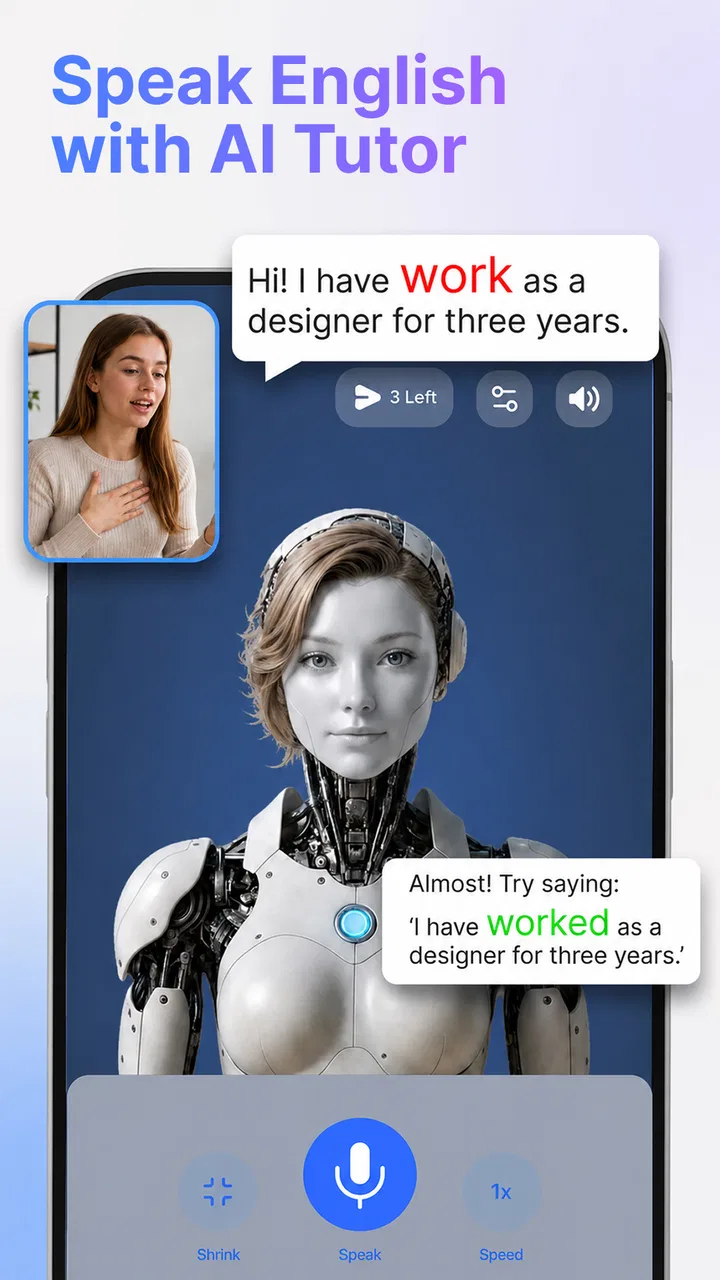
I approached Fluzy: Learn Language with AI as someone who wanted a practical way to move between English speaking practice and Korean study without turning language learning into a second job. It is an education app from Mall Collections, and its focus is clear: helping learners work with English and Korean in a more conversational way. That focus makes it easier to judge than a broad language catalog, because the useful question is not whether it teaches everything, but whether it fits the moment when I need to understand, remember, and use a phrase.
My overall impression is positive, with an important qualification. Fluzy makes the most sense as a regular practice companion rather than a complete replacement for a course, teacher, or structured textbook. Its free entry point is appealing, the Everyone age rating makes it approachable for a wide audience, and the app has attracted more than one million installs with an average rating of 4.4 from around 2.2 thousand ratings. Those numbers suggest a healthy level of interest, but they do not remove the need to consider how its workflow matches your own habits.
From a language-learning goal to a usable daily routine
The starting condition matters more than many people expect. If I already know exactly what I need—basic Korean practice before a trip, spoken English for work, or a way to keep new expressions active—Fluzy feels easier to use than an app that tries to cover every language and every learning style. The English-and-Korean pairing gives the experience a definite direction, so I would not install it expecting a general-purpose course for several unrelated languages.
You May Also Like

 Blood Strike: 2.5 Anniversary
Blood Strike’s Loadouts Turn Every Drop Into a Tactical Gamble
A close look at Blood Strike’s custom loadouts: how fast access to signature weapons reshapes its battle royale rhythm, rewards preparation, and narrows the gap between fights.

 Pandora - Music & Podcasts
Pandora’s Music Is Easy to Start, but Harder to Recover
Pandora’s strength is its low-effort path from a seed to a station. Its weak spot is how much confidence it asks you to place in connection, setup, and quiet recovery.

 8 Ball Pool
 Is Built on Rivalries, Rematches, and Routine
A close look at the rivalries, rematches, shared routines, and unanswered safety questions that turn a quick pool match into a persistent mobile community.

 Samsung Music
’s Quiet Strength Is Playing What You Already Own
Its reach comes less from spectacle than from dependable access to a personal library. That simplicity is both the app’s strongest retention engine and its ceiling.

 AccuWeather: Weather Radar
AccuWeather Review: A Quick, Clear Forecast for Everyday Decisions
For everyday plans, the best forecast is the one you can understand quickly. AccuWeather makes rain timing, radar, and local conditions easy to act on, with a few trade-offs.

 Hill Climb Racing
Why Hill Climb Racing Still Turns Crashes Into One More Run
A tiny car, a bumpy hill and one more upgrade: Hill Climb Racing keeps resurfacing because its simple chaos makes every near-miss feel personal.
More From Our News Desk



I also think the app is better suited to learners who want interaction around language rather than only a sequence of static lessons. The store summary presents it as an AI-assisted language-learning app for English speaking and Korean practice. In practical terms, that positioning encourages me to treat each session as a small attempt to produce or understand language, not simply as a quiz where I tap the right answer and move on.
That distinction is useful for a beginner who needs confidence, but it also exposes a limitation. An AI-oriented practice tool can help me get started, yet it does not automatically provide the complete progression that a carefully designed course gives me. I still need to decide whether I am practicing pronunciation, building vocabulary, reviewing grammar, or preparing for a particular conversation. Without that intention, short sessions can feel pleasant while producing less progress than expected.
The first practical step is deciding which side of the language pair deserves attention. Someone learning Korean from English may need a different routine from a Korean speaker improving English conversation. I would keep the goal narrow at the beginning: one everyday situation, one group of expressions, or one speaking problem. That makes the handoff from opening the app to actually using what I learn much clearer.
How I would use Fluzy in a normal day
Imagine that I am preparing for a short visit to Korea. I have a few minutes on a train and want to become more comfortable with greetings, ordering, and simple requests. I would begin with one situation instead of trying to absorb the whole language. After practicing, I would write down the expressions that still feel unfamiliar and later test whether I can recall their meaning without looking. The app becomes the input stage, while the real-world situation becomes the outcome I am working toward.
For English learners, the same workflow works in reverse. I might choose a workplace scenario, practice the wording I want to use, and then repeat it aloud away from the screen. That last step is important. Language apps can create a safe rehearsal space, but the handoff to a colleague, customer, classmate, or travel companion is where the skill proves useful. I would not judge a session only by how quickly I complete it; I would judge it by whether I can retrieve something later.
A helpful habit is to separate recognition from production. First, I check whether I understand an expression when I see or hear it. Then I close the app or look away and try to say the idea myself. This exposes a common weakness in app-based learning: recognizing an answer often feels like knowing it, while producing the same answer under pressure is harder. Fluzy is most valuable when I use it to reveal that gap instead of letting a smooth session disguise it.
I would also keep sessions deliberately small. A long list of new phrases can create the impression of progress while making later review difficult. A short set tied to one situation is easier to carry into a conversation. This is one of the less obvious trade-offs of using an AI-centered practice app: flexibility is useful, but flexibility also puts more responsibility on me to choose a sensible scope.
The handoff between app practice and real communication
The most important handoff is from an app response to my own voice. If I only read, tap, or mentally translate, I am training a narrower skill than the one I probably want. I would say each important expression aloud, then try to use it in a new sentence. For Korean, that may mean paying attention to the order and politeness of the full expression rather than memorizing an English equivalent word by word. For English, it may mean changing a formal phrase into something I would naturally say.
A second handoff is between a single correction and a broader pattern. If Fluzy helps me notice that one sentence is awkward, I should not treat that correction as an isolated fact. I would ask myself whether the problem comes from word order, tense, vocabulary choice, or simply a lack of familiarity. The app can support the moment of practice, but my notebook or another review method can preserve the pattern for later.
This is where Fluzy compares differently with common alternatives. Flashcard apps are often better when my main need is deliberate recall and spaced review. A traditional course is usually better when I want a fixed sequence, explanations, exercises, and a sense of what to study next. A private tutor is better when I need nuanced feedback about meaning, tone, or recurring personal mistakes. Fluzy’s appeal is the middle ground: more active than passive reference material, but less demanding and less personalized than a human lesson.
I would therefore pair it with one external habit rather than expecting it to do everything. A learner could keep a small list of phrases that repeatedly cause trouble, record a short self-introduction, or use a real conversation after practice. These additions turn app activity into a loop: encounter language, attempt it, notice friction, review the weak point, and try again.
What the result feels like after consistent use
The likely result is improved familiarity and greater willingness to attempt English or Korean, especially for learners who hesitate because they are afraid of making mistakes. That confidence has real value. A person who practices a useful phrase several times is more likely to use it than someone who keeps waiting until their grammar is perfect.
Still, I would be careful about promising fluency from this kind of routine. Speaking comfortably requires listening, recall, pronunciation, grammar control, and the ability to react when another person says something unexpected. A focused app can help with parts of that chain, but the result depends on what I do after each session. If I never listen to varied speakers or participate in real exchanges, my progress may remain comfortable inside the app and fragile outside it.
For a beginner, Fluzy can be a gentle first step because the goal is easy to understand and the price is free to start. For an intermediate learner, its value depends more on whether the practice challenges existing habits. I would recommend testing it with a specific problem, such as speaking more often or keeping Korean expressions active, rather than assuming it will automatically create an advanced study plan.
The free model also deserves a realistic look. Fluzy is listed as free, while in-app purchases range from about eight dollars to around two hundred dollars per item. That broad range means I would pay attention to what is included before committing to any purchase. A free download is useful for deciding whether the workflow fits me, but the presence of optional purchases makes it sensible to treat the trial period as an evaluation, not as proof that every part of the experience will remain free.
For families, the Everyone rating is reassuring in terms of the intended age range, but I would still choose the learning goal together with a younger learner. An age rating does not tell me whether the pace, explanations, or practice style will suit a particular child. A parent could make the app more effective by asking the learner to demonstrate one phrase after a session instead of measuring success by time spent on the screen.
Where the workflow can break down
The first weak point is unclear direction. If I open Fluzy without knowing whether I want speaking practice, Korean basics, or English maintenance, I may move through activities without building a coherent memory. The solution is simple but important: decide the outcome before starting. “I want to handle a greeting,” “I want to say this work request naturally,” or “I want to remember these travel expressions” is more useful than “I should study language today.”
The second weak point is overtrusting AI-style interaction. A response can sound helpful and still fail to explain the deeper reason a phrase works in one context but not another. This matters particularly for politeness, tone, and cultural expectations. I would use Fluzy for rehearsal and exploration, then verify important language through a teacher, trusted reference, or real conversation when the consequences of sounding unnatural are high.
The third is the gap between practice and retention. A learner can finish a session feeling productive and then forget most of it a day later. I would solve that by scheduling a quick recall check without the app: say the phrase from memory, translate the idea in both directions, and create a new example. If I cannot do that, the session gave me exposure but not yet reliable control.
There is also a fit issue for advanced learners. Someone who already holds long conversations may need detailed correction, specialized vocabulary, authentic listening material, or professional language. Fluzy may still be useful for warm-up practice, but I would not choose it as my only tool. Conversely, a complete beginner who wants a carefully ordered explanation of writing systems, grammar, and pronunciation may prefer a conventional course before adding flexible AI practice.
The current version is 1.2.2 and the app supports devices running Android 8.0 or later. That makes it accessible to many Android users, though anyone with an older device should check compatibility before planning a routine around it. I would also keep the app updated when possible, since language practice benefits from a stable experience and version changes can affect how familiar the workflow feels.
Who should make Fluzy part of the routine?
I would recommend Fluzy to a learner who wants a low-pressure way to practice English speaking or Korean, especially when short sessions are easier to maintain than formal study. It is a good candidate for commuters, travelers, shy speakers, and people who understand more than they can comfortably say. The app is also appealing if I want to move from passive study toward trying phrases in context.
I would be more cautious if my priority is a fully structured curriculum, exam preparation, advanced professional language, or expert correction of every mistake. In those cases, a textbook course, specialist platform, or tutor may provide a clearer route. Fluzy can sit beside those options, but it should not be mistaken for an automatic substitute.
My best practical advice is to give the app a defined job for a week: choose one language, one situation, and one observable outcome. At the end, try to use the material without looking. If I can recall and adapt several expressions, the workflow is earning its place. If I only recognize answers inside the app, I need more speaking, review, or a different learning method.
In the end, Fluzy is most convincing when I treat it as a bridge. It takes me from “I should practice” to a concrete attempt, then asks me to carry that attempt into daily life. The free starting point, focused English-and-Korean purpose, and accessible design make it worth trying, while the optional purchase range and the limits of AI-based practice call for sensible expectations. Its real strength is not replacing every language tool, but making the first active step easier to take.
That is why I would recommend Fluzy: Learn Language with AI to friends who need momentum and regular speaking practice, not to someone searching for a complete academic program. Used with a small review habit and real conversation, it can turn scattered interest into a repeatable routine. Used alone without a clear goal, it may feel engaging without delivering the lasting result the learner wants.
FAQs for Fluzy: Learn Language with AI
01What is Fluzy and how does it work?
Fluzy is an innovative language learning app powered by AI, designed to make acquiring a new language both engaging and efficient. The app uses cutting-edge technology to tailor lessons to your learning style, offering interactive exercises, real-time feedback, and personalized challenges to help you progress naturally.
02Which languages can I learn with Fluzy?
Fluzy offers a wide range of languages, including popular options like Spanish, French, German, Mandarin, and Japanese. The app frequently updates its language offerings, so users can explore lesser-known languages or dialects as well, ensuring a comprehensive learning experience.
03Is Fluzy suitable for beginners?
Yes, Fluzy is perfect for learners at all stages, including absolute beginners. The app begins with foundational vocabulary and grammar, gradually increasing in complexity. Its AI-driven approach adapts to your pace, ensuring you build a strong language foundation before moving on to more advanced concepts.
04Does Fluzy require an internet connection to function?
Fluzy does require an internet connection for initial setup and to access some features, like downloading new lessons or updates. However, many exercises and lessons can be downloaded for offline use, allowing you to continue learning without an active internet connection.
05Are there any subscription fees for using Fluzy?
Fluzy offers a free version with basic features, but for a more comprehensive experience, a premium subscription is available. The premium version provides access to advanced lessons, exclusive content, and ad-free learning. Subscription plans are flexible, catering to different budgets with monthly or annual options.
Pros
- Interactive AI-driven lessons.
- Wide variety of languages available.
- Customizable learning paths.
- Engaging language games.
- Offline mode for on-the-go learning.
Cons
- Limited free content options.
- Occasional AI translation errors.
- Requires internet for updates.
- No live tutor interaction.
- Premium features are pricey.

Fluzy: Learn Language with AI
Gallery